


What Else Can You Play or Do on a Puzzle Table

Summary: A puzzle table is a purpose-built surface originally intended for jigsaw assembly. Contemporary designs—with tilt, rotation, and integrated storage—have extended its utility into crafts (e.g., diamond painting), board and card games, model building, and other precision hobbies. This review examines functional design features, ergonomic benefits, practical use cases, and social/therapeutic implications, and concludes with implementation suggestions and FAQs.
Contents
- Introduction
- Functional Characteristics & Design Considerations
- Uses Beyond Jigsaws
- Ergonomics & Health Considerations
- Why Choose a Dedicated Puzzle Table
- Conclusion
- FAQ
1. Introduction: The Evolution of the Puzzle Table
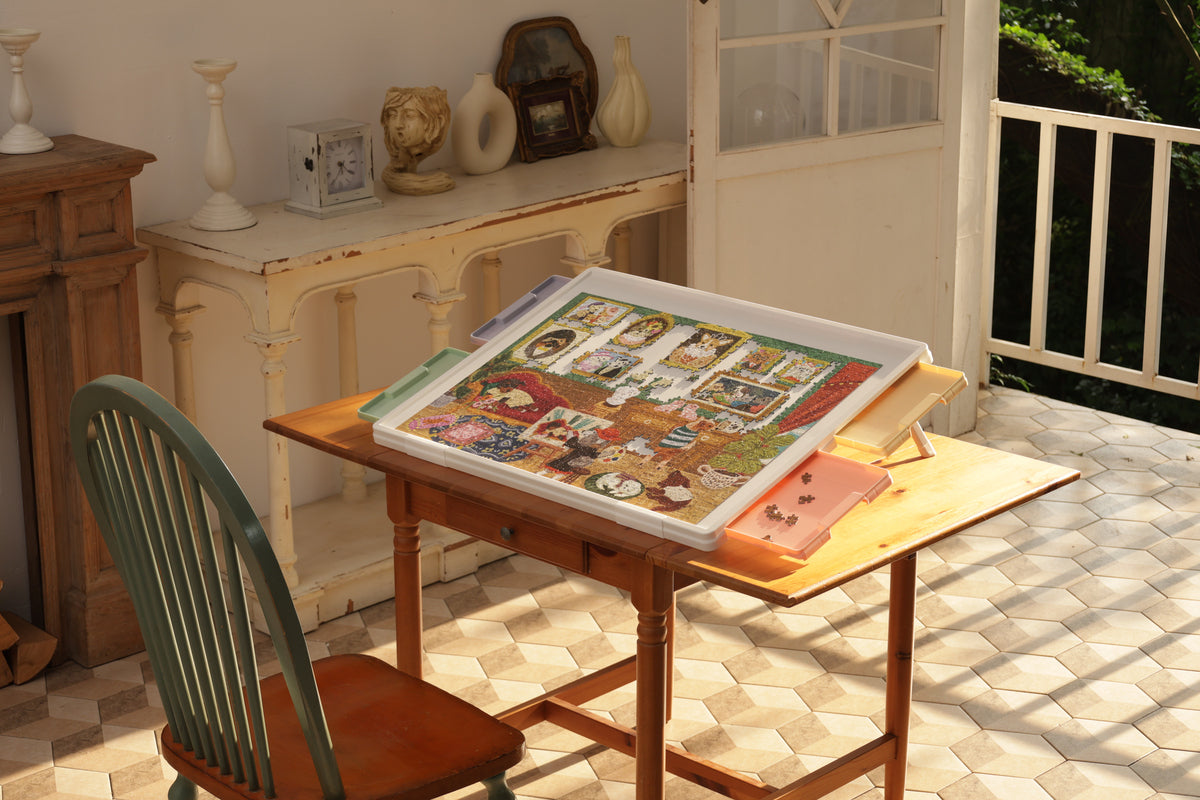
Historically, puzzle tables were conceived as specialized surfaces for the assembly of jigsaw puzzles—tasks that demand sustained visual attention, fine motor control, and the maintenance of piece order. Over the past decade, a convergence of hobby culture, ergonomics, and small-space living has driven the redesign of these surfaces. Contemporary models incorporate tilting mechanisms, 360° rotation, anti-slip textured tops, and integrated storage drawers, enabling the table to function as a multipurpose platform rather than a single-use item.
This article reviews the functional attributes that enable extended uses, enumerates related activities, and synthesizes ergonomic and psychosocial considerations.
2. Functional Characteristics & Design Considerations
A puzzle table’s versatility is determined by its material, load capacity, adjustability (tilt + rotation), storage configuration, and portability. A 10–30° tilt range helps maintain a neutral neck posture, while rotation minimizes repetitive reaching. Storage drawers reduce visual search load, enhancing workflow efficiency.
3. Uses Beyond Jigsaws
3.1 Diamond Painting
Diamond painting requires stability and fine motor control. Puzzle tables support long sessions thanks to their adjustable tilt and non-slip surface.
Our puzzle table is also perfectly suited for diamond painting.
3.2 Model Building & Beadwork
Small drawers assist with organizing beads, tools, and miniatures, making puzzle tables excellent stations for detailed craft work.
3.3 Board & Card Games
Puzzle tables provide a compact alternative to dining tables for game nights. The raised edges prevent pieces from sliding off, and rotation enhances equal access for all players.

3.4 Writing, Sketching, and Digital Tablet Work
Tilted surfaces reduce wrist strain for sketching or journaling, and can function as a workstation for digital tablet use.
3.5 Educational & Therapeutic Uses
In therapy and education, puzzle tables support spatial reasoning, dexterity training, and motor rehabilitation. The rotating board helps individuals with limited mobility remain engaged.
4. Ergonomics & Health Considerations
Proper tilt and rotation reduce cervical strain, shoulder tension, and cognitive overload. Alternating posture every 15–30 minutes improves comfort during long crafting or gaming sessions.
5. Why Choose a Dedicated Puzzle Table?
Standard coffee or dining tables are often too low or too high for close work. Puzzle tables solve these problems with ideal working height, integrated drawers, portability, and built-in rotation or tilt.
6. Conclusion
Puzzle tables have evolved into multiuse ergonomic workstations supporting jigsaw assembly, crafts, games, writing, and therapeutic activities. Material quality, adjustability, and storage determine the performance level across tasks.
7. FAQ
Q1: Can a puzzle table be used for diamond painting?
Yes. The stable top, tilt adjustment, and drawers make it ideal for diamond painting and beadwork.
Q2: Does rotation reduce strain?
Yes. Adjustability and posture variation decrease neck and shoulder fatigue.
Q3: What materials are best?
Laminated MDF or ABS with a removable felt/neoprene surface.
Q4: Can it replace a regular table?
It can temporarily replace one for close-work activities but is not a full substitute for dining or living room furniture.
Share


