

Home
Playboda Puzzle Blog
How to Make Your Own Folding Puzzle Board (DIY Guide + Smarter Alternatives)

How to Make Your Own Folding Puzzle Board (DIY Guide + Smarter Alternatives)
Summary: If you’re searching how to make my own folding puzzle board, you can absolutely DIY one with two panels, hinges, and a non-slip surface. However, most DIY folding boards solve storage—not the bigger everyday problems: reaching far corners, neck/back strain, and messy piece organization. This guide explains what works in a DIY build, what usually goes wrong, and when a rotating + tilting “two-in-one” board becomes the more practical long-term upgrade.
Jigsaw puzzles are relaxing—until your puzzle takes over the dining table for a week. If you’ve ever had to clear pieces for dinner, dodge a curious cat, or lose your sorting progress because life needed your table back, you already understand why people search how to make my own folding puzzle board. A folding board sounds like the perfect solution: build a surface, fold it up, slide it away, and pick up where you left off. The catch? Folding helps with storage, but it doesn’t automatically make puzzling more comfortable or organized. Let’s build the DIY version first—then talk about the upgrades that actually change your day-to-day puzzle experience.
Quick Answer: Can You DIY a Folding Puzzle Board?
Yes. A basic DIY folding puzzle board is typically two flat panels connected with hinges, covered with a non-slip surface, and optionally framed with a low edge to keep pieces from escaping. It’s a practical weekend project and a real upgrade over puzzling directly on a table.
But here’s the part most DIY tutorials skip: many folding boards still feel like “a table with a puzzle on it,” just easier to store. If you regularly do 1000–1500 piece puzzles, you’ll likely run into comfort and reach issues—especially on bigger layouts.
Why Puzzlers Want a Folding Board in the First Place
The strongest driver is simple: space. Most homes don’t have a dedicated puzzle room. So puzzles land on the dining table, coffee table, or kitchen island—the exact surfaces you need for everyday life. A folding board is appealing because it promises three things:
- Pause without losing progress: fold and store your puzzle safely.
- Share space with family: reclaim the table when you need it.
- Reduce disruption: fewer “dump everything in a box” moments.
One mom in Austin described it perfectly: “We’d start a puzzle after dinner, then by breakfast it was chaos. I needed something I could move fast—without re-sorting everything every time.” That’s the folding-board dream—and DIY can get you close.

Materials & Tools for a DIY Folding Puzzle Board
The materials you choose will determine whether your board feels sturdy and smooth—or wobbly, heavy, and frustrating. Here’s a reliable, beginner-friendly list:
Recommended materials
- Two panels: plywood or MDF (choose thickness that stays flat)
- Hinges: piano hinge (best stability) or 2–3 door hinges
- Surface layer: felt, cork sheet, or a non-slip mat material
- Optional frame: thin wood trim to create a low “lip” edge
- Adhesive: spray adhesive or strong glue for the surface layer
- Finish: sandpaper + sealant (if needed)
Tools
- Measuring tape + pencil
- Drill or screwdriver
- Utility knife (for surface material)
- Clamps (helpful, not required)
Step-by-Step: How to Build a Folding Puzzle Board
This is the simplest folding design that works well for most puzzlers. You’ll make a “book-style” board: it opens flat to puzzle on, then closes to protect your project.
Step 1: Choose your board size
Measure your most common puzzle size and add a little breathing room. If you routinely do larger puzzles, build bigger—but remember: bigger boards get heavier and harder to move.
Step 2: Cut two panels and sand edges
Keep edges smooth so fabric doesn’t tear and your hands don’t snag during long sessions.
Step 3: Attach hinges (the stability moment)
Lay panels flush and attach a piano hinge along the seam. If using door hinges, use 2–3 spaced evenly. The more stable your hinge line, the flatter the board will sit when opened.
Step 4: Add a non-slip surface
This is what keeps your puzzle from sliding when you lift or reposition the board. Felt is popular because it adds friction and feels “puzzly,” but make sure it’s evenly glued—wrinkles will annoy you later.
Step 5 (optional): Add a low frame edge
A shallow lip helps keep pieces from drifting, especially if someone bumps the table or you need to move the board quickly. Don’t make it too tall, or it becomes uncomfortable on your wrists.
Step 6: Test folding + storage
Close it, open it, carry it around the house. If it feels too heavy now, it will feel worse when a full puzzle is on it.
Where DIY Folding Boards Usually Fall Short
DIY folding boards can be genuinely useful—but most people build them to solve a single problem: storage. In real life, puzzling has at least four more pain points, and this is where “just a folding board” can disappoint.
1) Reach: big puzzles still have “far corners”
On large layouts, you’ll still end up leaning, stretching, or walking around the table. If you puzzle on a dining table, that reach problem gets worse because the surface is wider than your comfortable arm span.
2) Comfort: flat boards encourage neck/back strain
A flat surface means you’re looking down for hours. Even with good posture, long sessions often lead to tight shoulders and a sore neck. Many puzzlers try to fix this by stacking books under the board… which introduces a new issue: slipping.
3) Organization: no drawers, no sorting workflow
The most time-consuming part of puzzling isn’t placing pieces—it’s searching. DIY boards rarely include integrated drawers, so pieces still live in bowls, zip bags, or random trays. The “where did I put the edge pieces?” question never goes away.
4) Weight: sturdy DIY often becomes not-so-portable
A stable board is usually heavier—especially if you chose thick wood so it won’t warp. That weight makes the board harder to move when dinner happens, when guests arrive, or when you simply want to puzzle near the TV.
A retired teacher in Phoenix shared a common story: she built a folding board that looked great— but after a week she stopped moving it because it felt like “lifting a small door.” Her board solved storage, but not comfort, reach, or daily convenience.

A More Comfortable Option: Rotating + Tilting Two-in-One Boards
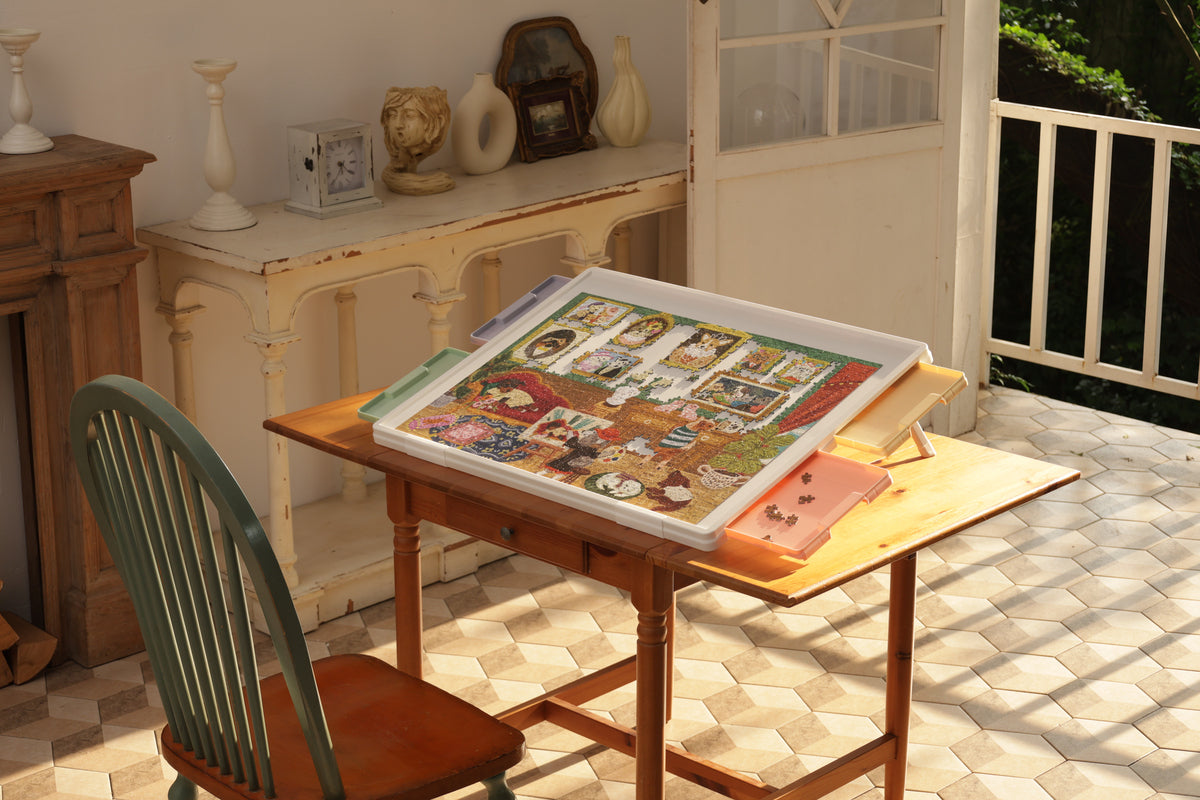
If your goal is not just “store my puzzle,” but “actually enjoy puzzling more,” this is where rotating + tilting boards change the experience. Rotation solves reach: you bring the puzzle to you. Tilt solves comfort: you reduce that constant forward neck bend. And integrated storage solves workflow: pieces stay sorted, visible, and ready.
If you’re looking for a two-in-one option that combines rotation, a tilt stand, and drawers—and also includes a cover for project protection— see: Playboda 1500-Piece Rotating & Tilting Puzzle Table with Drawers and Cover .
Practical example: In a shared household, it’s common to start a puzzle at the dining table, then move it near the couch for a relaxing evening. A rotating + tilting board makes that shift painless: you rotate to reach the far edge, tilt for comfort, and keep pieces contained and sorted.
DIY vs Two-in-One: How to Decide
Choose DIY if you genuinely enjoy building and you mainly need a way to store a puzzle safely. Choose a rotating + tilting board if you puzzle often and want to improve comfort, reach, and organization—every single session.
- DIY folding board: best for budget, customization, and light use
- Two-in-one board (rotate + tilt): best for frequent puzzlers, larger puzzles, and long sessions
Conclusion: Build It, or Upgrade Your Puzzle Routine
A DIY folding puzzle board is a solid weekend project and a real improvement over puzzling directly on the dining table. But if you’re still struggling with reach, posture, or piece organization, folding isn’t the finish line—it’s just the first step.
If you want the “why didn’t I do this sooner?” upgrade—especially for 1500-piece projects—consider a rotating + tilting setup designed for everyday puzzling comfort: Shop the Playboda Rotating & Tilting Puzzle Table (Comfort Series) .
FAQ
Can I make my own folding puzzle board at home?
Yes. Two flat panels + hinges + a non-slip surface is the simplest reliable build. Add a low edge if you want extra containment.
What material is best for a DIY puzzle board?
Plywood is often lighter than MDF at similar stiffness. MDF can be very flat but may become heavy. A felt or textured top helps reduce sliding.
Why do puzzle boards need rotation?
Rotation solves the “far corner” problem. Instead of leaning across a big puzzle, you rotate the surface and keep a comfortable posture.
Does a tilting stand really help?
For many puzzlers, yes. Tilt reduces the amount of forward neck bend during long sessions—especially helpful for adults who puzzle for hours.
Is a cover necessary?
If you puzzle in shared spaces (pets, kids, dust, fans), a cover helps protect your work between sessions and reduces accidental disruption.
Share
3 comments
thank you for these directions.
i cannot find the answers that i sent to customer service . please help. will your answers be sent to my email or do i have to look somewhere on your web site? thank you
thank you for these directions.
i cannot find the answers that i sent to customer service . please help. will your answers be sent to my email or do i have to look somewhere on your web site? thank you
thank you for these directions.
i cannot find the answers that i sent to customer service . please help. will your answers be sent to my email or do i have to look somewhere on your web site? thank you


