

Home
Playboda Puzzle Blog
How to Make a Puzzle Board That Holds Your Puzzle and Pieces (Complete Guide)

How to Make a Puzzle Board That Holds Your Puzzle and Pieces (Complete Guide)
Summary: A functional puzzle board needs four key components: a stable main surface, a textured top to prevent sliding, raised edges for containment, and dedicated space for sorting pieces. This guide explains materials, dimensions, DIY building methods, common issues, ergonomic tips, real user experiences, and when it might be better to buy a ready-made rotating or tilting puzzle board.
1. Introduction: Why Make Your Own Puzzle Board?
If you’ve ever tried assembling a 1000-piece puzzle on a dining table, you’ve probably experienced the same frustrations: pieces sliding everywhere, missing edge pieces, having to clear the table for meals, and losing track of your carefully sorted color groups. A dedicated puzzle board solves these problems by giving you a contained, movable, and protected workspace.
For many puzzlers, building a DIY puzzle board is appealing because it can be customized to fit specific puzzle sizes, storage needs, and small living spaces. Some enjoy the building process itself; others simply want a cheaper alternative to a premium rotating or tilting puzzle board.
However, DIY boards often come with trade-offs: excessive weight, warping, lack of storage, or poor portability. This guide walks you through how to make a puzzle board that can hold both your puzzle and your pieces—and how to decide whether DIY or a ready-made solution is the better choice for you.
2. Essential Components of a Puzzle Board That Holds Puzzle & Pieces
Before you pick up any tools, it’s important to understand what makes a puzzle board truly functional. A board that only looks nice but bends easily, lets pieces slide off, or offers no space for sorting will quickly become a source of frustration.
2.1 Stable Surface Material
The main surface must stay flat and resist bending over time, even when you move it from room to room. Common choices include:
- MDF / plywood: very stable and strong, but often heavy.
- ABS / PVC panels: lightweight, durable, and less prone to warping.
- Foam board: inexpensive and light, but bends and dents easily.
- Felt or textured overlays: used on top to add friction and reduce sliding.
2.2 Raised Edges for Piece Containment
One of the most common failure points in DIY designs is the absence of raised edges. Without a shallow frame around the perimeter, even small movements can send pieces cascading onto the floor.
In general, aim for edges that are:
- About 0.5–1 inch high.
- Smooth enough not to damage puzzle pieces.
- Continuous around all four sides for full containment.

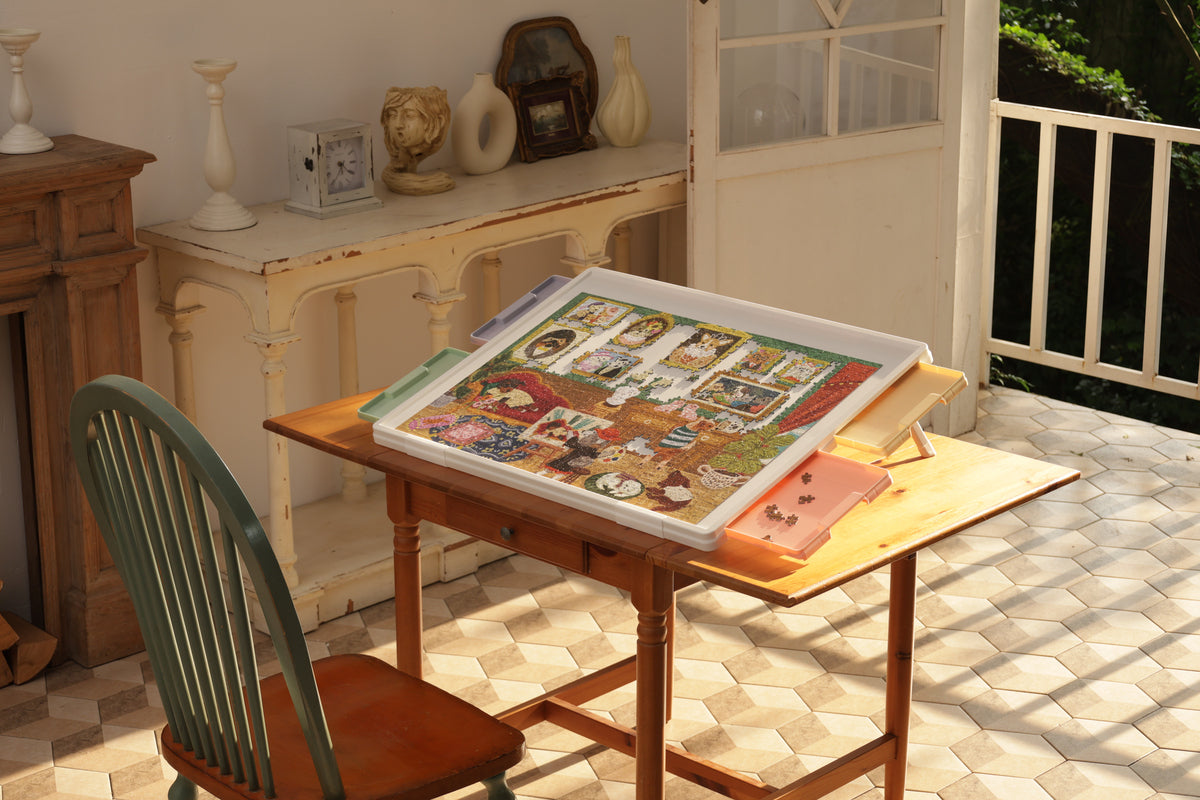
2.3 Sorting Space or Drawers
A good puzzle board doesn’t just hold your in-progress puzzle—it also gives your loose pieces a well-organized home. Sorting by color, pattern, or shape significantly speeds up the puzzling process and reduces visual clutter.
Sorting options include:
- Slide-out wooden drawers under the main board.
- Removable sorting trays that nest underneath.
- Side-mounted trays or boards for edge pieces and color groups.
If you prefer a ready-made solution with built-in sorting, you can explore puzzle boards with integrated drawers.
2.4 Portability and Weight
While solid wood is strong and stable, it can quickly become too heavy to move comfortably. Foam board is light but often too fragile for long-term use. Modern ABS-based puzzle boards strike a good balance between rigidity and portability.
As a rule of thumb, if you want to move the board between rooms, try to keep the weight under about 10 lbs.
2.5 Optional Enhancements
To bring your DIY board closer to a premium product, you can add:
- A rotating base (lazy-susan style) to reach any side without stretching.
- A tilting stand to improve neck comfort during long sessions.
- A removable felt mat to fine-tune friction and make cleaning easier.
- A dust cover, especially useful if you live with pets.
For an off-the-shelf option with these features, consider browsing 360° rotating puzzle boards.
3. DIY Methods: How to Make Your Puzzle Board
Below are three practical DIY methods, ranging from beginner-friendly to more advanced woodwork. Choose the one that best fits your tools, budget, and expectations.
3.1 Method 1: Foam Board + Felt Layer (Lightweight & Budget-Friendly)
Best for: small apartments, students, or casual puzzlers.
Materials:
- Two thick foam boards.
- Felt fabric or flocked poster board.
- Spray adhesive.
- Masking tape for edge reinforcement.
Steps:
- Cut both foam boards to at least 30" × 22" for a standard 1000-piece puzzle.
- Glue the boards together to increase stiffness.
- Attach felt to the top surface using spray adhesive.
- Reinforce the edges with tape to protect against dents.
Pros: low cost, very light, fast to make.
Cons: warps easily, no built-in storage, limited lifespan.

3.2 Method 2: MDF or Plywood Board + Trimmed Edges (Strong & Durable)
Best for: frequent puzzlers who want stability similar to professional boards.
Materials:
- ¼–½ inch MDF or plywood.
- Wood trim pieces for the edge frame.
- Wood glue and clamps.
- Sandpaper.
- Optional: clear acrylic sealer.
Steps:
- Cut the main board to 30" × 22" (or 35" × 27" for oversized puzzles).
- Cut trim pieces to frame all four edges of the board.
- Glue the trim in place, clamp, and let it dry thoroughly.
- Sand all edges smooth and apply sealer if you want a more wipeable surface.
Pros: excellent stability, long-lasting, “premium” feel.
Cons: heavy, less friendly to move and store.
As one user in Chicago reported: “My DIY wooden board looked beautiful but weighed almost 18 pounds. After the first day, I basically never moved it.”
3.3 Method 3: Hybrid Board with Drawers (Advanced DIY)
Best for: hobbyists who want functionality close to a professional puzzle table.
Materials:
- Flat plywood or ABS panel for the top.
- Pre-made craft drawers or small organizer boxes.
- Drawer slides or simple rails.
- Wood screws or strong epoxy.
Steps:
- Build or attach a base frame that can house the drawers.
- Install drawer slides beneath the main board.
- Mount the drawers and test that they slide smoothly.
- Check clearances so the drawers don’t interfere with your legs or seating.
Pros: closest DIY option to a high-end puzzle board.
Cons: requires more tools, time, and precision.
If you prefer to skip this level of complexity, you can look at puzzle boards with 4 integrated drawers instead.
4. What Size Should You Build?
Puzzle sizes vary more than most people expect. Choosing the wrong dimensions is one of the most frustrating mistakes because it’s hard to fix after the board is built.
Recommended minimum dimensions:
- For most standard 1000-piece puzzles: 30" × 22".
- For oversized brands (e.g., White Mountain, Springbok): 35" × 27".
If you’re unsure which brands or piece counts you’ll tackle next, it’s safer to overbuild and choose the larger size, especially if you have enough storage space.
5. Common Issues & How to Avoid Them
Some DIY mistakes show up over and over again. Here’s how to avoid them:
- Foam board bending: laminate two boards together or switch to MDF/ABS if you need more rigidity.
- Surface too slippery: add felt, neoprene, or a textured PVC sheet to increase friction.
- Board too heavy: avoid thick plywood and full hardwood; choose thinner panels or ABS.
- No space for sorting: add detachable trays, side tables, or shallow drawer modules.
- Edges too high or too low: aim for a 0.5–1 inch height to balance containment and accessibility.
- Unsafe to move: consider adding handles or reducing board thickness to make lifting easier.
If you want a lighter, low-risk alternative, you can explore modern ABS puzzle boards designed for portability.
6. Real User Stories & Experiences
Case 1: Small Apartment Puzzler (New York)
“I made a foam board puzzle board because my apartment is tiny. It was fine for the first week, but eventually it bowed in the middle. I switched to a rotating ABS puzzle board and the difference in stability was huge.”
Case 2: Woodworking Enthusiast (Portland)
“Building a wooden board with proper trim was satisfying. But it was almost too nice and too heavy to move. If I build again, I’ll integrate drawers and aim for a lighter core.”
Case 3: Senior Puzzler (Florida)
“DIY boards were simply too heavy for me. I eventually moved to a tilting puzzle board because I can’t lean over for long. The tilt made puzzling comfortable again.”
7. Should You DIY or Buy a Ready-Made Puzzle Board?
7.1 DIY Is Best For People Who:
- Enjoy crafting or woodworking projects.
- Already own basic tools and materials.
- Have a tight budget.
- Don’t need to move the board frequently.
7.2 Buying Is Better For People Who:
- Want rotation or tilt functions out of the box.
- Need a lightweight, portable board.
- Prefer built-in drawers and organized storage.
- Want a durable, long-lasting product with fewer DIY risks.
For convenient, ready-to-use solutions, you can explore:
- 1000-piece tilting puzzle boards for better neck and back comfort.
- Rotating puzzle tables with storage drawers for both organization and easy access.

8. FAQ
Q1: What's the best material for a puzzle board?
MDF and ABS are both strong options. MDF offers excellent stability but is heavier, while ABS is lighter and often more suitable if you plan to move the board frequently.
Q2: How do I stop puzzle pieces from sliding?
Add a layer of felt, neoprene, or textured PVC to the surface. These materials increase friction so pieces stay in place even if the board is bumped or tilted slightly.
Q3: What size should a puzzle board be for 1000 pieces?
For most 1000-piece puzzles, aim for at least 30" × 22". If you frequently do oversized brands, consider 35" × 27" to ensure you have enough working area.
Q4: Can I add drawers to my DIY board?
Yes. You can use small craft drawers with simple rails or full drawer slides attached beneath the main board. Just make sure the board remains stable and balanced when drawers are open.
Q5: Is DIY cheaper than buying a ready-made board?
In most cases, DIY is cheaper in terms of raw materials, but the trade-offs include time, required tools, potential design mistakes, and lack of advanced features like rotation or tilt. Many puzzlers find that a well-designed ready-made board offers better long-term value.
9. Conclusion
A DIY puzzle board can absolutely hold both your in-progress puzzle and your sorted pieces—as long as you choose the right materials, build to the correct dimensions, reinforce the edges, and provide adequate storage for loose pieces. For some puzzlers, especially those who enjoy hands-on projects, DIY is both practical and rewarding.
For others, the convenience, ergonomics, and durability of a professionally designed rotating or tilting puzzle board make buying the smarter choice. When in doubt, prioritize:
- A minimum working area of 30" × 22".
- A textured top layer for grip.
- Raised edges for containment.
- Some form of organized storage for your pieces.
And if you’d rather spend your time puzzling instead of building, consider upgrading straight to a board that’s designed for puzzlers from day one.
Share


