


How to Build a Tabletop Slanted Puzzle Board

If you’ve ever spent hours working on a jigsaw puzzle, you know the joy of seeing the picture come together piece by piece. But you also know the pain: leaning forward for long stretches, craning your neck, and reaching for faraway corners. Most puzzle boards on the market, and especially DIY versions, are nothing more than a flat board. They give you a surface, but not much else.
Over time, manufacturers introduced rotating puzzle boards. These boards spin on a base, allowing you to bring hard-to-reach corners closer. It’s a clever solution, but it still leaves one problem unsolved: the discomfort in your neck and back from constantly bending over. That’s why the best solution isn’t just rotation—it’s tilt. A slanted puzzle board keeps your neck and posture comfortable, making puzzling more sustainable and enjoyable.
Why Tilting Matters
Think about reading a book. You wouldn’t want to place it flat on the floor and lean over it for hours. You hold it up at an angle that feels natural. Puzzling is the same. Tilting a puzzle board even slightly reduces strain, aligns your eyesight, and helps you focus longer without discomfort.
Some puzzlers try to solve this by propping up the back of the board with books or household items. While this works in theory, it has its drawbacks:
-
Too steep: Pieces slide down and the puzzle becomes unstable.
-
Too flat: The tilt isn’t enough to relieve neck strain.
-
Unstable base: Makeshift supports wobble or collapse if bumped.
That’s why finding the right angle and support system is key.

DIY: How to Build a Tabletop Slanted Puzzle Board
If you want to experiment with tilt, here’s a basic DIY method:
-
Start with a flat puzzle board: This can be wood, MDF, or ABS. It should be sturdy enough to support the puzzle.
-
Add a stable backing: Attach strips of wood or non-slip material to prevent sliding.
-
Create an incline: Place thick books, yoga blocks, or wedges under the back edge. Aim for a tilt of about 20–30 degrees—enough to ease strain, but not so steep that pieces slide.
-
Secure the surface: Use a puzzle mat or anti-slip sheet to keep pieces from shifting.
-
Test and adjust: Try puzzling for 30 minutes. If your neck still hurts, raise the angle slightly. If pieces start sliding, lower it.
This DIY method works, but it requires trial, error, and constant adjustments.
A Smarter Solution: Puzzle Boards with Built-in Tilt
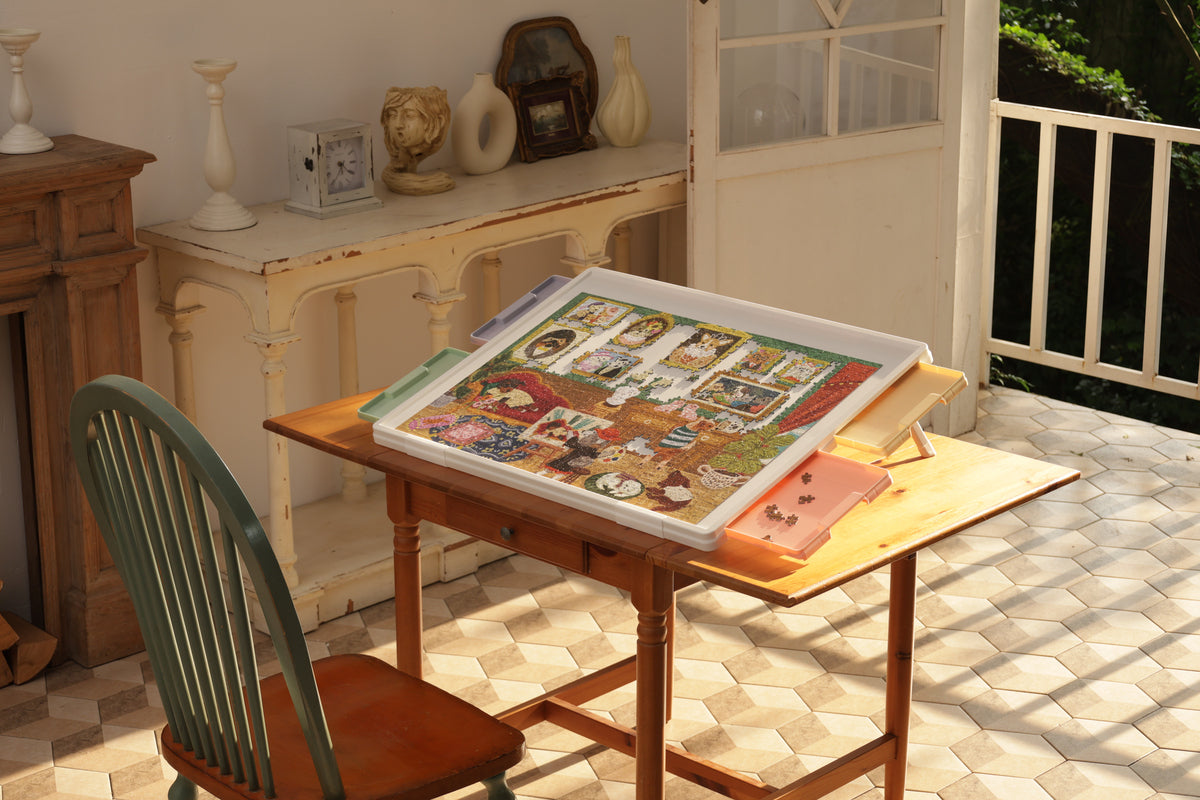
Instead of experimenting with makeshift props, many puzzlers now prefer puzzle boards designed with built-in tilt. They give you the perfect angle every time, without slipping or wobbling. Combined with rotation, drawers, and protective mats, they solve every major puzzle frustration in one product.
George, 61, retired architect from Chicago, shared his story:
“I tried propping up my old wooden board with encyclopedias. It sort of worked, but the pieces kept sliding, and my wife hated the mess. When I bought a Playboda board with tilt, it was like night and day. My neck feels fine even after hours, and the puzzle stays perfectly in place.”
Emma, 37, graphic designer from New York, explained:
“I used to puzzle flat on the table and would quit after half an hour because my shoulders were sore. Now I tilt the board and can lose myself for two or three hours. It feels like my hobby finally fits into my lifestyle.”

Why Playboda Boards Stand Out
At Playboda, we designed our boards around real puzzlers’ needs. Our boards are:
-
Slanted for comfort: Adjustable tilt angles to protect your neck and back.
-
Rotating for reach: Spin the board to bring any section closer.
-
Organized: Color-coded drawers to sort and store pieces.
-
Protected: A cover mat keeps your puzzle safe from pets, kids, or spills.
-
Portable: Lightweight ABS makes it easy to carry from table to bed or sofa.
This combination means you don’t have to choose between DIY hacks and discomfort. You get the perfect setup, every time.
Building a DIY slanted puzzle board is possible—you can stack books or blocks under a flat board and hope for the best. But a wobbly base or sliding pieces can turn relaxation into frustration.
A purpose-built slanted puzzle board, on the other hand, delivers comfort, stability, and joy in every puzzling session. Whether you’re finishing a 1000-piece picture of a sunset or tackling a 1500-piece challenge, your board should support you—not strain you.
👉 Ready to upgrade your puzzling experience? Explore our [Puzzle Boards Collection] and discover why so many puzzlers call Playboda the best puzzle board they’ve ever owned.
Share


