

Are Puzzles Board Games?

Summary: Strictly speaking, jigsaw puzzles aren’t board games—board games rely on rules, turns, and player interaction, while puzzles emphasize calm focus and completion. Yet in practice, puzzles now fill many of the same roles as modern board games: screen-free entertainment, family connection, and satisfying brain work. This guide compares definitions, shares data trends, explores hybrid “puzzle-game” crossovers, and shows how puzzle boards make puzzling more social and ergonomic.
Are puzzles actually board games? Purists will say “no,” but real households tell a richer story. As home entertainment evolved, jigsaw puzzles have become the quiet twin of competitive board games—equally table-worthy and just as meaningful. Below we unpack definitions, highlight data-backed trends, and share real user stories that illustrate how puzzles fit into today’s tabletop culture.
1. What Defines a Board Game?
A board game typically requires two or more players, a shared play surface, explicit rules, and a win/lose or scoring condition. The experience is interactive and dynamic—your choices affect others, and luck or strategy often swing outcomes. Think Catan, Ticket to Ride, Pandemic, and classics like chess or checkers.
Market context: Industry reports consistently show steady growth in the global board-game category through the mid-2020s, with family/strategy titles leading shelves and social feeds. The appeal is simple: structured play that creates laughter, rivalry, and memorable table talk.
“Every Friday our family plays a route-building game. Winning is fun, but the real win is that everyone shows up to the same table.” — Jason, Seattle
2. What Defines a Puzzle?
A puzzle is a self-contained challenge—no opponents needed. The goal is to assemble a coherent image (jigsaw), solve a logic pattern, or complete a spatial task. The reward is completion and the flow state along the way. There’s no meta-game, no dice, no turn order; just deliberate progress at your own pace.
Behavioral snapshot: Adult puzzlers commonly spend 5–15 hours on a 1000-piece jigsaw, often over multiple sessions. After 2020, puzzle participation jumped and remained elevated as people sought screen-free calm, mindful focus, and tactile satisfaction.
“I used to scroll my phone to unwind. Now I pour a cup of tea, open my puzzle drawers, and feel my shoulders drop.” — Emily, Florida
3. Key Differences at a Glance
| Aspect | Board Games | Puzzles |
|---|---|---|
| Players | 2+ with interaction | 1–4 (collaborative but calm) |
| Goal | Win, score, or outplay | Complete the picture/problem |
| Rules & Structure | Turns, constraints, trade-offs | Self-paced, no external rules |
| Emotional tone | Tension, surprise, table talk | Calm, focus, meditative flow |
| Replayability | High—each game differs | Moderate—fixed solution |
Bottom line: puzzles don’t fit the strict, competitive definition. But they satisfy a similar human itch—progress, mastery, and shared time at a table.
“Finishing a 1500-piece panorama gives me the same dopamine spike as a clever endgame—minus the trash talk.” — Mark, Texas

4. Where Puzzles Behave Like Board Games
In real homes, puzzles have drifted into board-game territory:
- Puzzle nights replace game nights for a quieter vibe.
- Speed-puzzling and team challenges add friendly competition.
- Hybrid titles (escape-room puzzles, mystery kits) mix story, deduction, and cooperative play.
Community participation reflects the shift: online puzzle clubs have swelled into the hundreds of thousands, and seasonal events draw large virtual crowds. The draw isn’t beating someone; it’s building something together.
“We set a timer, split tasks, and cheer when someone finds that elusive sky piece. It’s our holiday tradition now.” — Sarah, Ohio
5. The Role of Puzzle Boards (Rotation, Tilt, Drawers)
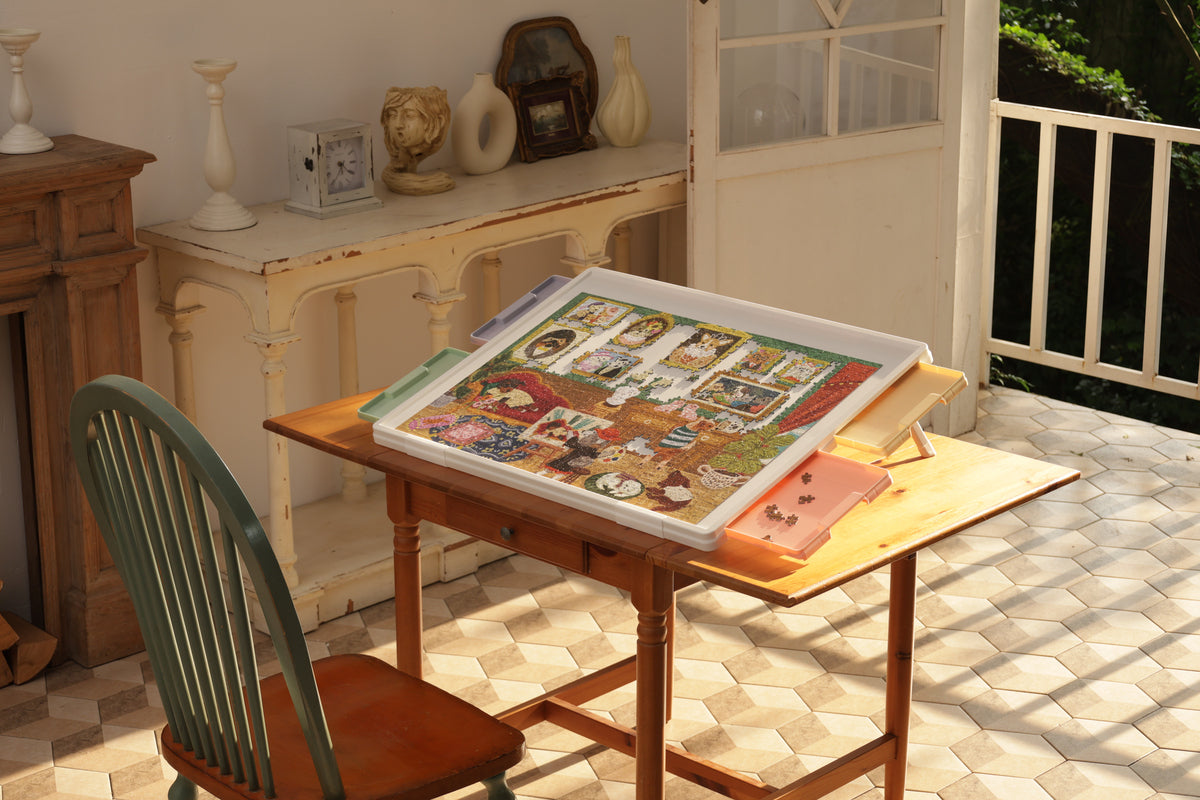
Puzzle boards are the bridge between solitary puzzling and social tabletop play. Purpose-built boards introduce:
- Rotating platforms to reach corners without leaning.
- Tilted stands that ease neck/back strain for long sessions.
- Sorting drawers & protective covers to organize pieces and pause safely around pets/kids.
- Portability so you can reclaim the dining table and resume later—intact.
Consumer interest mirrors the utility: searches for terms like “puzzle board with drawers,” “rotating puzzle board,” and “tilting puzzle board” have grown markedly since 2022, as ergonomics and order became household priorities.
“Our rotating board turned puzzling into a social circle—everyone can reach, and no one’s craning their neck.” — Linda, New York
6. Who Enjoys Puzzles vs. Board Games?
The audiences overlap heavily:
- Families seeking screen-free connection and routines kids can join.
- Adults craving mindful downtime after work.
- Seniors maintaining cognition, dexterity, and social rhythm.
Studies of cognitive leisure activities frequently associate regular puzzling with gains in attention, short-term memory, and spatial reasoning—benefits similar to those observed in strategic board-game play.
“Whether it’s puzzles or a strategy game, the point is connection—sometimes with others, sometimes with yourself.” — Dr. Rachel Kim, therapist
7. Verdict: Are Puzzles Board Games?
Technically, no. Puzzles don’t require turns, rules, or opponents, so they sit outside the classic definition. Functionally, yes. In today’s homes, puzzles belong to the same tabletop family—bringing people together, exercising the brain, and marking time with something tangible and beautiful.
If board games make the table lively, puzzles make it peaceful. Both make the table matter.

8. FAQ
Are jigsaw puzzles considered board games?
Not strictly. They’re tabletop activities without opponents or turn-based rules, but they share the same space and many of the same benefits.
Why do families treat puzzles like board games?
Because puzzles deliver a shared goal, steady progress, and conversation—hallmarks of a great game night, just at a quieter tempo.
Do puzzle boards make puzzling more social?
Yes. Rotation, tilt, and better organization help multiple people participate comfortably at once.
What size puzzle is most “board-game-like” for groups?
1000-piece puzzles hit a sweet spot: challenging, visual, and doable over a weekend with two to four people.
Is puzzling good for the brain?
Research on cognitive leisure suggests regular puzzling supports focus, memory, and problem-solving—similar to strategic tabletop play.
Share


